
What the Heck Is It? The Stories Behind The Weirdest Things Sold at Auction

Each week in the Gray's newsletter, we ask a simple question: What the Heck Is It?
Sometimes it's a scientific instrument that looks like it belongs in a mad scientist's laboratory. Other times, it's a military machine that appears ready to drive straight through anything. And often, it's an object that seems perfectly ordinary until you learn the story behind it. That's where things get interesting.
Collectors know that curiosity is often the gateway to appreciation. You don't have to recognize every unusual auction treasure immediately. You simply need to ask the right question, then let history do the rest.
Here are five real lots sold by Gray's Auctioneers that prove the strangest antiques often have the best stories.
What the Heck Is It?
1. An Austrian Military Truck That Refuses to Retire
At first glance, the 1972 Steyr-Puch Pinzgauer 710M looks like the sort of vehicle that should come with a map, a mountain range, and no concern for paved roads.
Originally developed for the Austrian military, the Pinzgauer earned a reputation for exceptional off-road capability thanks to its portal axles, high ground clearance, four-wheel drive, locking differentials, and compact design. Unlike many military vehicles built simply to survive difficult terrain, the Pinzgauer was remarkably capable while remaining mechanically straightforward to maintain. It eventually served military organizations and emergency services throughout Europe and beyond.
The Gray's example retained its original 2.5-liter gasoline engine, manual transaxle, transfer case, and seating for up to ten passengers. That's less "weekend grocery run" and more "let's see what's on the other side of that mountain."
Collectors clearly appreciated its originality.
Estimate: $10,000-$12,000
Sold: $13,000
Maybe someone thought it was time to make school drop-off a little more interesting. Or maybe the classrooms were in the most remote jungle. The 4x4 is sure to get there regardless.
2. The Pocket Watch That Refused To Be Fashionably Late
Pocket watches have been replaced by wristwatches, smartphones, smartwatches, even the microwave clock.
They've also become surprisingly collectible.
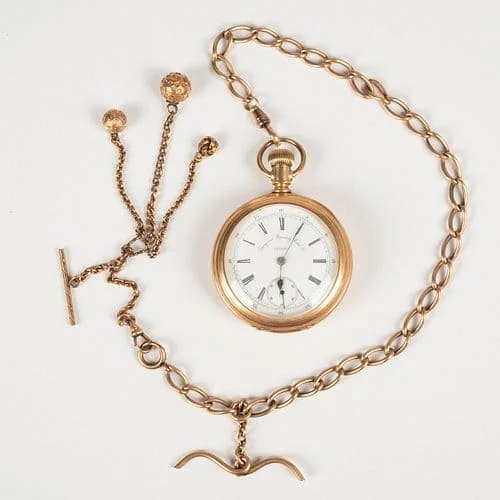
This Timing and Repeating Watch Co. Geneva pocket watch included a 14-karat gold chain and was engraved with the Odd Fellows motto, Friendship, Love and Truth, connecting it to one of America's largest fraternal organizations.
The Independent Order of Odd Fellows, founded in 1819 in Baltimore, was essentially the 19th century’s answer to a social network (minus the algorithms, plus a lot more ceremonial regalia). Despite the name sounding like a group of Victorian eccentrics who meet to discuss peculiarity, the organization was actually dedicated to friendship, charity, and truth, with elaborate rituals and mottos that showed up proudly on items like this watch chain.
Estimated at $100-$200, this watch inspired determined bidding before ultimately selling for $2,400.
Good timing never goes out of style.
3. The Artist Who Nearly Stayed Hidden
Some artists become household names.
Others quietly wait for collectors to rediscover them.
American painter John Teyral built a respected career as an artist, educator, and muralist, studying at the Cleveland School of Art before later teaching there himself. His work balanced classical draftsmanship with modern influences, and his figure studies reveal remarkable confidence in anatomy and composition.
His 1936 Study of a Male Nude shows why collectors still seek his work today. The painting possesses both technical precision and an immediacy that still feels contemporary nearly ninety years later.
Gray's Auctioneers estimated the painting at $2,000-$4,000.
Collectors had different ideas.
It sold for $17,000.
Sometimes the market just needs some time to catch up with the artist’s reputation.
4. Pocket-Sized Navigation Over 200 Years Before GPS
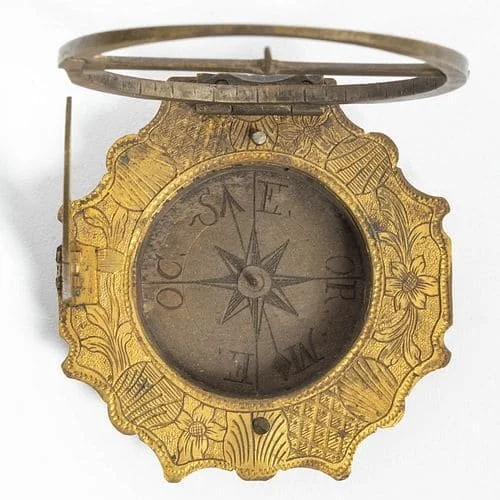
Long before satellites quietly told us we'd missed our exit, travelers relied on considerably more elegant solutions. This 18th-century brass sundial and compass by Andreas Vogler combines two essential navigational tools into one beautifully engineered instrument.
When properly aligned with true north, the compass lets the folding gnomon cast a shadow across the engraved dial, revealing local solar time. The reverse includes engraved latitude references for European cities, allowing travelers to adjust the instrument depending on where they were. Merchants, military officers, scholars, and well-traveled gentlemen prized these compact scientific instruments throughout the eighteenth century.
In other words, it was the original travel app, no shared location required.
5. Advice from an Aviation Legend
Few names represent adventure quite like Amelia Earhart. Before becoming one of history's most famous aviators, she was equally determined to encourage others to fly.
Her signed first edition of The Fun of It offered readers an optimistic, personal look at aviation during an era when powered flight still felt astonishingly new. Published before her disappearance over the Pacific in 1937, the book captures Earhart at a moment when flying represented possibility alongside mystery.
The first woman to fly solo across the Atlantic Ocean, Earhart spent much of her career encouraging women to pursue aviation despite considerable social barriers. Her influence on aviation history extends well beyond the circumstances of her final flight.
Signed copies remain highly desirable because they combine literary history, aviation history, and one of the twentieth century's most enduring historical figures. The bidders agreed. With an estimate of $1,000, this copy sold for $1,700. Sometimes the story matters just as much as the signature on the cover.
Why Collectors Love Curious Auction Lots
One of the greatest misconceptions about antiques is that value comes only from age.
Age helps. History helps more.
Collectors respond to remarkable design, unusual engineering, fascinating provenance, and, occasionally, an object that's simply unlike anything they've seen before. That's why strange antiques become the conversation pieces people remember long after an auction closes.
At Gray's, every auction contains familiar names alongside the unexpected. Those unexpected discoveries often become the lots everyone talks about afterward.
Which brings us back to our favorite question:
What the heck is it?
Usually, the answer is more interesting than anyone expected.
Curious About Consigning?
Do you own something unusual but aren't quite sure what it's worth?
You're not alone.
Many of the most memorable lots sold at Gray's began with a simple conversation and a valuation. Whether it's scientific instruments, jewelry, decorative arts, fine art, furniture, or the wonderfully difficult-to-identify object that's been collecting dust for decades, we'd love to take a look.
Request your valuation today and discover what story your collection has to tell.
FAQs
What kinds of unusual auction finds sell well?
Fine art, contemporary art, furniture, decorative arts, jewelry, and niche items like scientific instruments, rare books, and objects with strong provenance attract collector interest. Condition, rarity, authenticity, and historical significance all contribute to value.
How do I consign with Gray's Auctioneers?
Contact Gray's to schedule a complimentary valuation. The specialists will review your items, discuss estimates and auction timing, and guide you through the consignment process from start to finish.